


What happens when a centralized crypto exchange tries to be the “front door” to Web3 while keeping the safety nets of a traditional trading venue? That tension — between convenience and custody, between speed and exposure — is exactly the practical question a U.S.-based trader should ask when considering OKX for spot trading, wallet use, staking and cross-chain activity.
This article unpacks how OKX stitches together a CEX, a Web3 wallet, a DEX aggregator and an NFT marketplace into one product, what that means for spot traders, and where assumptions commonly go wrong. I’ll show one useful mental model for deciding when to keep funds on OKX versus moving them into non-custodial storage, explain the mechanics behind their spot/margin stack, and point out operational limits that matter in the U.S. regulatory and UX context.
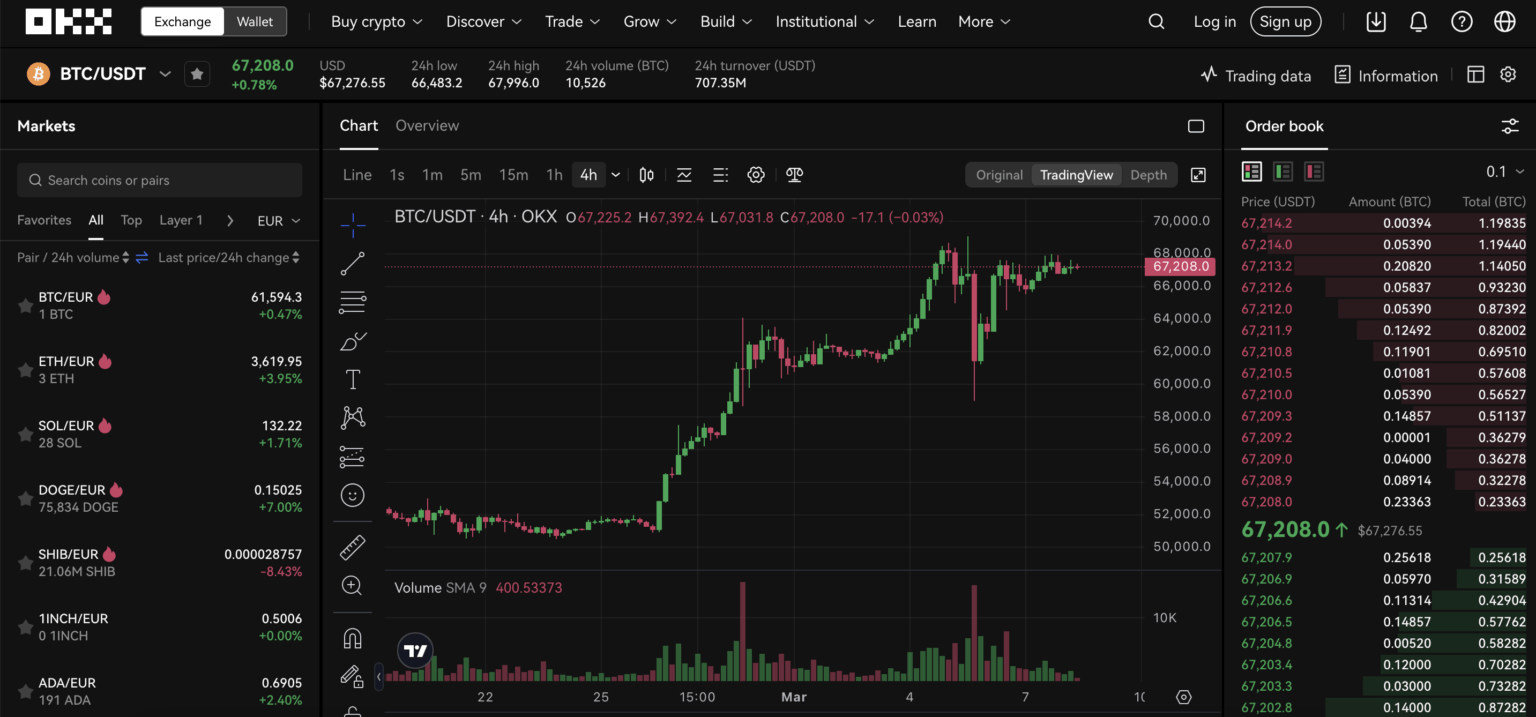
OKX is not merely a spot exchange. Architecturally it combines a centralized order book and custody layer with a non-custodial Web3 wallet, a DEX aggregation layer, an NFT marketplace and yield products (staking and farming). For traders this is meaningful because it compresses several normally separate actions — buy on CEX, withdraw to wallet, bridge across chains, stake in DeFi — into fewer clicks. That reduces friction but also concentrates different risk types in one ecosystem.
Mechanically, here’s the chain of capabilities: the CEX side executes spot orders against a centralized matching engine with advanced TradingView charting and margin modes (isolated and cross up to 10x leverage), while the Web3 wallet sits either as an integrated custodial option or as a non-custodial seed-phrase wallet (supporting hardware wallets). The DEX aggregator routes swaps across liquidity pools to improve execution for cross-chain swaps. That combination explains why many traders treat OKX as both a primary trading venue and their on-ramp to Web3 activity.
Spot trading here is straightforward: you place market or limit orders against the order book, and you can toggle margin lending to amplify a view. What traders often underestimate are the execution-layer trade-offs: slippage and liquidity. OKX supports over 300 cryptocurrencies and sources liquidity across many pairings, but low-volume tokens still suffer wide spreads and price impact. During fast moves, market orders can fill well away from the quoted price — a universal exchange problem, not unique to OKX.
If you plan to trade larger sizes or thin altcoins, the decision framework should be: (1) check order book depth and recent trade size, (2) prefer limit orders where latency matters, (3) simulate execution cost by splitting large trades, and (4) use the DEX aggregator for cross-chain swaps when the CEX pair is thin (but expect fees and slippage there too). For those who want a fast login and trade flow, the platform’s web app and mobile app (the latter promoted recently as a mainstream “money app” in app stores) reduce friction — but speed should not trump pre-trade liquidity checks.
Account security and login matter because centralized custody means you don’t hold the private keys for assets kept on-exchange. OKX layers military-grade encryption, AI-powered threat detection for suspicious logins, and mandatory Two-Factor Authentication (2FA) (SMS, Google Authenticator, or biometrics). For U.S.-based traders, a sensible checklist before trading:
– Use hardware-backed biometrics on mobile when possible; avoid SMS 2FA as the sole factor for large accounts.
– Enable AI-detection alerts and review every unknown device login immediately.
– Keep KYC materials current to avoid delays in withdrawal during volatility. Account creation requires ID and a facial liveness check, which can slow redeposits or withdrawals if documentation flags.
If you need a short, practical route to the login page and onboarding instructions, this resource explains the steps in a user-oriented way: okx login.
One persistent myth is “on-exchange assets are risk-free.” Reality: centralized platforms like OKX lower certain operational risks — corporate custody, insured processes, cold-storage practices (OKX claims over 95% of assets in air-gapped cold wallets with multi-sig controls) — and provide Proof of Reserves so users can verify a 1:1 backing on-chain. Those are concrete protections against solvency opacity that have historically plagued some venues.
But other risks remain external to the exchange: phishing campaigns targeting login credentials, smart contract exploits when using integrated DeFi tools, and the irreversible consequences of lost seed phrases for self-custodial wallets. The correct mental model is a spectrum of custody: for active spot trading and margin operations, leaving working capital on the CEX is convenient and operationally efficient; for long-term holdings or significant amounts, the expected security improvement from moving assets to a hardware-backed personal wallet often outweighs the convenience loss.
OKX offers flexible staking, locked staking, and DeFi-style yield farming with features like auto-compounding. For a U.S. trader, the decision to stake on-platform versus manual DeFi strategies comes down to three trade-offs: yield level, counterparty risk, and liquidity timing. On-platform staking is easy and often provides lower operational risk (no smart contract interaction by the user), but locked products reduce liquidity and may be subject to the exchange’s operational rules for distributions.
The integrated NFT marketplace simplifies minting and trading across Ethereum, Solana, and Polygon with creator royalties enforcement. NFTs are attractive for collectors and creators, but they are illiquid and carry market-structure risks: pricing discovery is primitive, and royalties may not be enforced off-platform. Treat NFTs as an illiquid allocation: small exposure, careful research, and attention to on-chain provenance.
OKX provides derivatives (quarterly futures, perpetuals, options) with up to 125x on some instruments and margin up to 10x in isolated/cross modes for spot margin. Leverage amplifies returns but also increases the probability of liquidation. Two practical heuristics: (1) use isolated margin to cap the downside to a single position rather than risking entire account equity, and (2) size risk using volatility-based metrics (e.g., ATR) rather than fixed percentages alone.
Also note funding-rate mechanics and liquidity skew: during stressed moves, funding rates can spike and widen, and execution becomes more expensive. Perpetuals can be efficient for hedging but are fragile under sudden liquidity withdrawals. Advanced traders should combine position sizing, stop rules, and scenario testing rather than relying solely on platform margin limits.
The DEX aggregator and cross-chain bridges are powerful when you need to move tokens between networks without manually routing through multiple exchanges. By sourcing liquidity from major DEXs, OKX’s aggregator finds optimized swap routes which can materially reduce slippage for cross-chain tasks. However, cross-chain transfers remain subject to bridge risk: smart contract vulnerabilities, delayed finality on certain networks, and occasionally long settlement times during congestion.
Another boundary condition is regulatory friction. U.S. users face a more constrained landscape: some derivatives and certain token listings may be limited or unavailable to U.S. accounts to comply with AML/KYC rules and local restrictions. Expect the platform to enforce identity checks and to block services that local law would restrict — a compliance reality, not a technical failure.
A decision-useful framework I recommend: split crypto assets into two pools. The “working capital” pool lives on OKX (or any CEX) and is sized to cover active trading, liquidity needs, margin requirements, and short-term staking. The “reserve” pool is self-custodial (hardware wallet or cold storage) for long-term holdings and larger positions you are unwilling to risk to centralized custody or short-term market dynamics.
How to size each pool? Consider your average trade frequency, maximum potential margin exposure, and an emergency withdrawal buffer. A conservative rule: keep no more than the amount you could lose without catastrophic personal-finance consequences on-exchange; move the rest into a hardware wallet where you control the seed phrase. This splits operational convenience from catastrophic risk — and it’s simple to implement.
Several developments would materially alter the practical advice here: widespread adoption of on-chain solvency proofs with automated third-party verification, new U.S. regulatory guidance that clarifies which derivatives are permissible, or novel custody insurance products priced affordably for retail users. Conversely, an uptick in large-scale phishing campaigns or a major DeFi bridge exploit integrated with OKX would push me to recommend a smaller on-exchange working-capital allocation.
Short-term signals to monitor: changes to KYC/withdrawal windows for U.S. customers, funding-rate volatility on perpetuals, and updates to OKX’s Proof of Reserves disclosures. These indicators are operationally decisive during stress events.
“Safe” is relative. OKX uses robust cold-storage practices and provides Proof of Reserves, which reduces certain counterparty risks. But keeping everything on any centralized exchange exposes you to custody risk, phishing, and platform-specific operational issues. Use the working-capital vs. reserve split to manage exposure.
Spot trading settles at current market price and involves owning the asset. Margin trading borrows funds to amplify exposure (up to 10x on OKX in margin modes). Margin increases liquidation risk and requires monitoring of maintenance margins and cross-position interactions.
Yes — OKX provides a non-custodial Web3 wallet compatible with many DApps and supports hardware wallets. However, interacting with DeFi introduces smart contract risk; only connect to audited contracts and limit amounts staged for interaction.
Enable 2FA (prefer app-based or hardware/bio methods over SMS), turn on device/notification alerts, use unique passwords, and link hardware wallets for large withdrawals or cold storage transfers. Keep KYC documents updated to avoid hold-ups in stressful markets.
In short: OKX is a pragmatic hybrid — it reduces many frictions that used to make on-ramps to Web3 slow, while keeping the familiar trading features of a centralized venue. That blend is useful, but it doesn’t eliminate traditional trade-offs. Use the custody split framework, treat integrated DeFi features as convenience tools with distinct risks, and monitor liquidity and compliance signals to adapt sizing and tactics. Thoughtful, operationally grounded choices matter far more than platform slogans.